
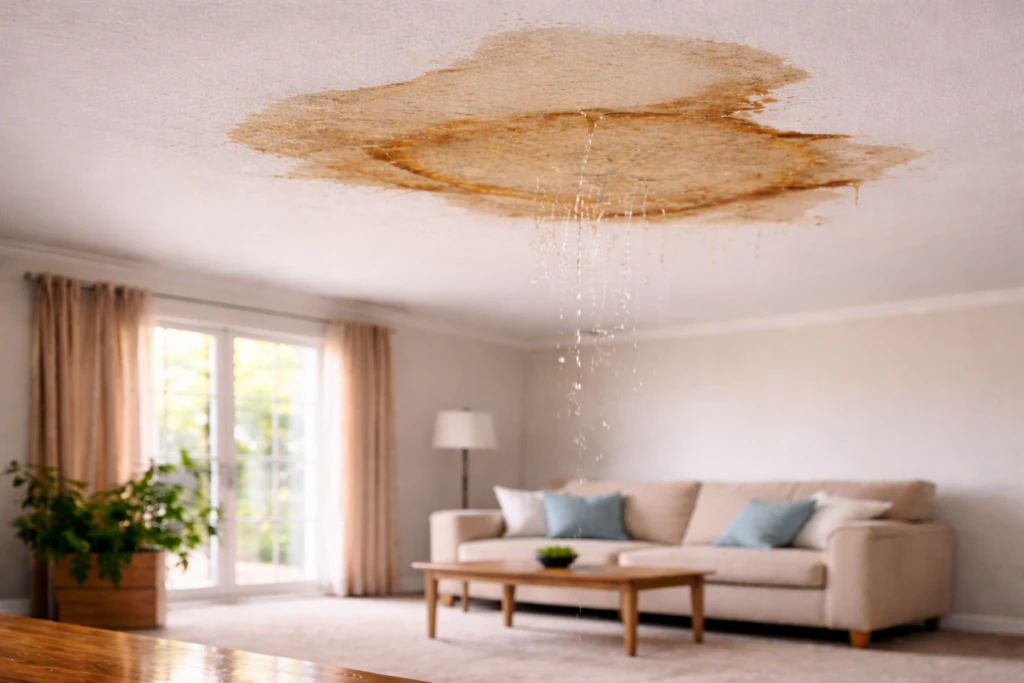
A water stain on your ceiling is often a roof leak, but plumbing and air conditioning cause plenty of them too. Timing is the best first clue. A stain that spreads after rain points to the roof, one that grows in dry weather points to a pipe, and one that appears on hot days while the AC runs points to its drain. Find the source before you paint, because paint won't stop the water.
Brown rings on a ceiling get blamed on the roof almost by default. Sometimes the roof is guilty. Often it isn't, and no roofer can fix a leaking shower drain.
The stain itself can tell you a lot if you watch when it changes and note where it sits. The attic usually tells you the rest.
How can you tell if a ceiling stain is from the roof?
Watch when it changes. The day you notice the stain, draw a light pencil line around its edge and date it. Check it after the next rain, and again after a dry week.
A stain that grows after rain but not in dry spells means water is getting in from outside, so the roof is the first suspect. Growth on dry days points indoors: to a pipe, or to the AC if it happens on hot, sticky days while the AC runs hard.
Position matters too. Roof leaks show up on top-floor ceilings, often near an outside wall, a chimney, a skylight or a plumbing vent pipe. Water also travels before it drips. It can run along the roof deck or down a rafter and land well away from the hole. Start looking directly above the stain, then work uphill along the rafters.
In a two-story house, think about which room sits over the stain. A stain on the dining room ceiling, right under an upstairs bathroom, is a plumbing question first. Rain would have to get past the attic and the second floor and run down inside a wall to land there. It happens, but a worn toilet seal, a shower pan or a supply line is the likelier culprit.
What else causes a brown stain on the ceiling?
A brown stain only tells you that water soaked in and dried. The EPA's list of common moisture problems in buildings includes leaking roofs, leaking or condensing water pipes, and gutters that send water into a building. It also points to poorly draining air handler drain pans as a hiding place for moisture (EPA mold course).
| Likely source | When the stain grows | Where it usually shows | What you may find |
|---|---|---|---|
| Roof or flashing leak | During or after rain | Top-floor ceilings, near outside walls, chimneys, skylights or roof vents | Wet insulation and dark patches on the roof deck above |
| Plumbing leak | Any time, rain or not | Below bathrooms, kitchens or a laundry room | Steady growth, sometimes after a shower or a flush |
| AC condensate drain | Hot, humid days with the AC running | Near the air handler, if it sits in the attic | Water standing in the drain pan, or a rusted pan |
| Condensation in the attic | Humid weeks, with or without rain | Along duct runs or near a bathroom fan | Damp duct insulation under a dry roof deck |
The AC deserves a hard look in Dallas and the rest of North Texas, where it gets little rest in summer. As it cools, it pulls water out of the air, and that water drains from a pan under the indoor unit through a condensate line. If the air handler sits in your attic and the line clogs or the pan rusts through, the water lands in the ceiling. The EPA advises keeping AC drip pans clean and drain lines flowing (EPA guide to mold and moisture).
Ducts can drip too. A cold duct running through a hot attic can sweat if its insulation is torn or missing. The EPA says ducts in spaces that aren't air conditioned should be sealed and insulated to prevent condensation. A bathroom fan that blows into the attic adds moisture up there. The Department of Energy's Building America Solution Center says those fans should vent outdoors, not into the attic (Building America guidance).
What should you look for in the attic?
Look for water where it shouldn't be: wet insulation, a damp roof deck or a full AC drain pan. If you can get up there safely, the attic usually settles the question. Go in the cool of the morning with a good flashlight, and step only on joists or a walkway. A foot through the drywall turns one ceiling repair into two.
To find the spot above the stain, measure how far it sits from an outside wall in the room below, then measure the same distance in the attic. Check for:
- wet or matted insulation
- dark streaks or soft patches on the underside of the roof deck, especially around the chimney, vent pipes and skylights
- daylight around a pipe or where the roof meets a wall
- nail tips with rust or water drops on them, a sign of moisture from a leak or from condensation
- water in the AC drain pan, a rusted pan, or a drain line that has come apart
- damp duct insulation, or a bathroom fan duct that ends in the attic
After a rain, a wet roof deck right above the stain is about as clear an answer as you'll get. A dry deck above a full drain pan or a sweating duct points away from the roof. Take photos either way. If you can't get up there safely, leave it to a roofer or an HVAC technician.
Does a ceiling stain after rain always mean a roof leak?
Not always. Gutters and upstairs windows let rain in too, and when the roof is to blame, the shingles often aren't.
Flashing is the usual suspect. It's the metal that seals the joints where the roof meets a wall or a chimney, and around skylights. When it lifts or its sealant cracks, water runs in behind it. The rubber boot around a plumbing vent pipe is another weak point, because sun and heat dry it out until it splits. Both are roof repairs, even when the shingles look fine.
Gutters can do it too. When they clog or pull away from the fascia, water spills behind them into the top of the wall and leaves a stain along the edge of the ceiling. The EPA lists cleaning and repairing gutters as a moisture-control step. If yours overflow or are pulling loose, the fix is in the gutters rather than the roof, and if they need replacing, that's gutter installation work.
Upstairs windows are the other common route. Wind-driven rain gets behind trim that has lost its caulk and runs down inside the wall. If the stain only shows after storms from one direction, look hard at that side of the house. If it appeared right after hail, have the roof checked for hail damage as well.
What should you do about the stain today?
Photograph it with something in the frame for scale, and keep the dated pencil lines going. If it's dripping, put a bucket under it and move furniture and electronics away. If water is pouring in during a storm right now, start with what to do while your roof is leaking.
Some signs mean it can't wait:
- The ceiling sags, bulges or feels soft. Keep people and pets out from under it.
- Water is near a light fixture, fan or smoke alarm. Switch that circuit off at the breaker until the area is dry and an electrician has checked it.
- There's a musty smell, or dark spots are spreading.
Don't wait for the next storm to prove it's the roof, either. A slow leak soaks the same insulation and drywall every time it rains. If you're tempted to leave it, read what a small roof leak costs if you wait.
When can you paint over a water stain on the ceiling?
Only once the source is fixed and the ceiling is fully dry. Paint over a damp patch and the stain comes back.
The EPA is plain on this. Dry wet materials quickly, and don't paint over mold, because paint on moldy surfaces is likely to peel. Its guide also explains which mold you can clean up yourself and when to call a professional.
Drywall that has gone soft or saggy needs cutting out and replacing, and wet insulation above it should be dried or replaced. On sound, dry drywall, painters seal the stain with a stain-blocking primer first. Ceiling paint on its own tends to let the stain bleed back through.
How does Fit Roofing & Construction handle a ceiling stain?
When the signs point to the roof, our job is to find where the water gets in and fix that spot. Roof repair at Fit Roofing & Construction covers leak detection, flashing repair and sealing, and shingle replacement, and we repair asphalt shingle, metal and tile roofs. If a leak has soaked the attic insulation, insulation replacement is part of our attic insulation service.
We work on homes and businesses across Dallas-Fort Worth.
If the roof turns out to be sound, call a plumber or an HVAC technician next. Your notes on timing and position will help them too.
What's the next step if you've found a stain?
- Mark and photograph the stain, then watch it through the next rain and the next dry spell.
- Check the attic above it, if you can do that safely.
- Call the trade that fits what you found: a roofer for a wet deck or failed flashing (see roof leak repair), a plumber for a stain under a bathroom, an HVAC technician for a full drain pan or sweating ducts.
- Paint only after the cause is fixed and the ceiling has dried out.