
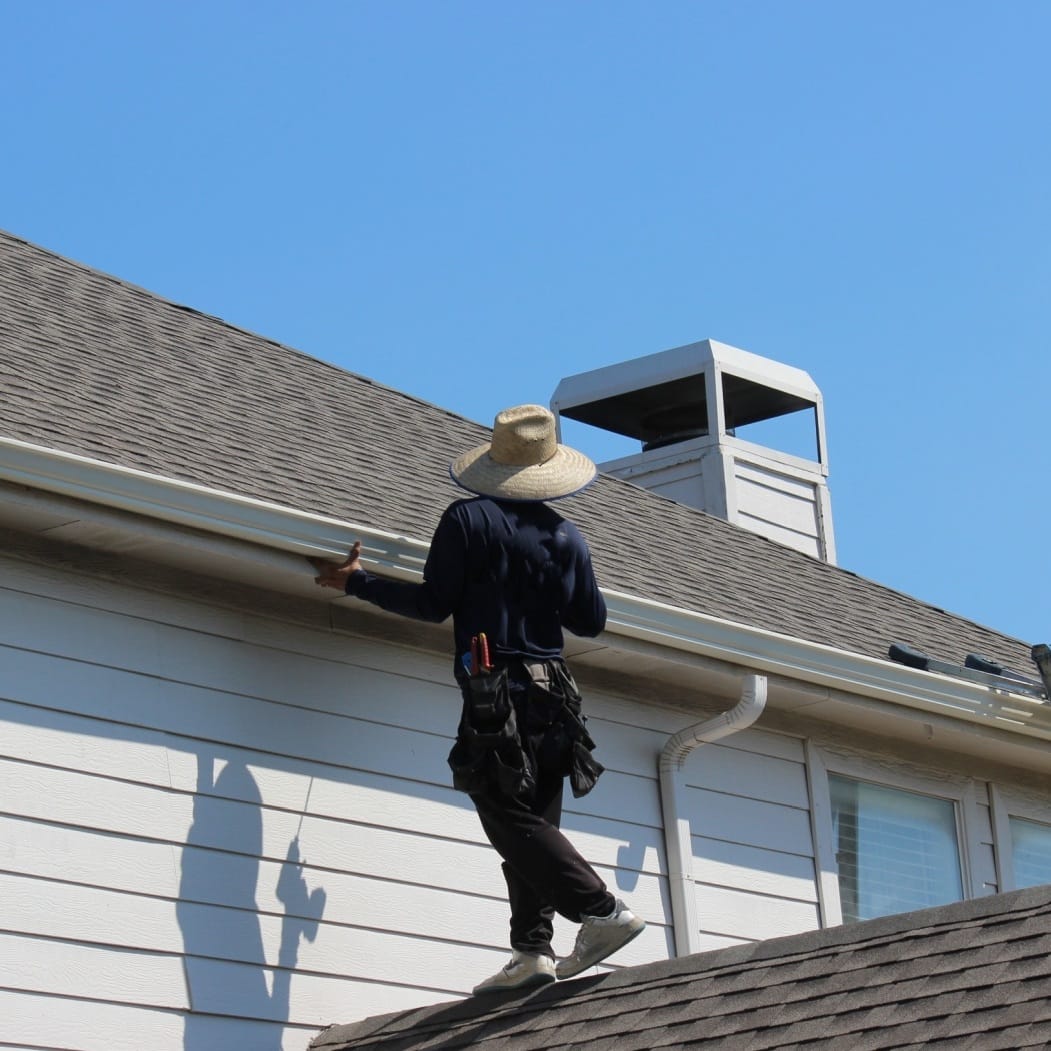
Replace your gutters when you replace your roof if they are dented, sagging, leaking at the joints, spilling over in a hard rain even when clean, or hanging from soft, rotten fascia. If they are straight, drain to the downspouts and are fixed to solid wood, you can keep them. The roofer then has to protect them during the tear-off and leave them sitting under the new drip edge. Make the call before the old shingles come off, because the roof edge and the gutters get worked on together.
A roof and its gutters meet along one narrow strip at the eaves, and a roof replacement rebuilds that strip from the deck up. So the gutters belong in the roofing plan from the start. Below is how the two fit together, what a tear-off does to old gutters, which ones are worth keeping and the order the work should go in.
This post sticks to the re-roof decision. For the bigger picture on what gutters do for a house, see how Texas gutters protect your home from water damage.
How are the gutters and the roof edge connected?
They share the eave. Along the bottom edge of a shingle roof runs a strip of bent metal called drip edge. It throws water clear of the edge, which helps keep it from curling back onto the fascia board and the wood deck and rotting them. The Asphalt Roofing Manufacturers Association strongly recommends drip edge on all shingle roofs and points out that local codes may require it.
At the eave, the drip edge normally goes on before the underlayment. That makes it part of building the new roof, not a piece of trim added at the end.
The gutter hangs just below it. Gutter makers' installation instructions have you slip the back of the gutter under the drip edge, so water coming off the roof drops into the gutter instead of running down behind it. When the roof edge is rebuilt, the gutter is right there in the way.
What happens to old gutters during a tear-off?
The crew either takes them down first or works around them. Either way, they take some punishment.
Gutters are thin metal. Ladders lean on them, and the old shingles, nails and underlayment all slide over them on the way down. A run that was already tired can come out of that bent or pulled loose.
Some gutters do not hang from the fascia at all. They hang from straps nailed to the roof deck and tucked under the first row of shingles. A tear-off disturbs every one of those straps.
Putting gutters back is harder than it sounds. Each run is hung with a slight fall toward its downspout, and one rehung a little off holds water in the low spots or spills at the far end. Once the gutters are down, you also see the fascia for the first time in years. If it is soft, nothing should go back on it until it is replaced.
Which gutters should you replace with the roof, and which can stay?
Judge them on the metal, the drainage, what holds them up and the wood behind them, and on color if the look of the house matters to you. This is how the signs usually split.
| What to look at | Replace them with the roof | Keeping them is reasonable |
|---|---|---|
| The gutter itself | Dents, rust, leaking joints, patched sections | Straight runs, tight joints, no rust |
| How it drains | Spills over in a downpour, holds standing water | Water runs to the downspouts and clears |
| What holds it up | Loose spikes or nails, sagging runs, hangers pulling out | Hangers screwed into solid fascia |
| The fascia behind it | Soft, stained or rotten wood | Sound, dry wood |
| The color | Clashes with the new shingles | Works with the new roof |
Spilling over needs a closer look before you blame the gutter. A gutter that overflows may be clogged, pitched wrong, short of downspouts or too small for the roof above it. Cleaning fixes the first problem. The rest need new work, and a re-roof is the sensible time to do it.
What if hail is the reason for the new roof?
Then look hard at the gutters before anyone decides. Hail that bruises shingles dents soft metal too, including gutters, downspouts and vent caps. After a spring hailstorm in Plano, for instance, stand at a corner of the house when the sun is low and sight along the face of each gutter. Dents show up as dimples and shadows. Dented downspouts are easy to miss and easy to photograph.
If insurance is involved, check your policy and talk to your insurer. Our post on the first steps after a hail storm has the other checks worth making after hail.
What order should the roof and the gutters go in?
Roof first, gutters last. If the gutters are being replaced, the old ones come down before or during the tear-off. The crew strips the roof, swaps out any rotten decking and repairs or replaces damaged fascia. The drip edge, underlayment and shingles go on next. The new gutters go up after that, tucked under the finished drip edge and hung with a steady fall toward each downspout.
That order keeps falling debris off brand-new gutters. It also means the gutters are hung to fit the new roof edge.
Keeping your old gutters changes only the first step. They come down or get protected, the roof goes on, and then they are rehung or checked so the fall is still right. Ask the crew to run a hose into the high end of each run before they leave. It shows straight away whether the water reaches the downspout.
Is it cheaper to do the gutters and the roof at the same time?
It can be, though the saving is mostly in time and hassle rather than in the price of the gutters. One company plans both jobs and cleans up after both. Nobody has to come back months later to work along the edge of your new roof.
The bigger gain is at the joint. The roof edge and the gutter work as one piece, and they fit best when one plan covers both. When two companies work on that edge at different times, the second has to fit its work to the first, and if water later gets behind the gutter, it is hard to say whose work let it in.
New gutters are not automatically part of a re-roof, though. Paying to replace sound gutters buys you very little. Ask for them to be priced as a separate line, so you can see the cost and decide for yourself.
What should you ask your roofer about the gutters?
Ask these before you sign, and get the answers in writing.
- Will you take my gutters down for the tear-off or work around them?
- If you keep my gutters and they get bent, who pays to fix them?
- Will the new drip edge hang into the gutter, not behind it?
- If the fascia is rotten, will you replace it before the gutters go back up?
- Will you check the fall to every downspout once the gutters are back?
- Are the downspouts, elbows and extensions included, or only the gutters?
Can Fit Roofing do the roof and the gutters together?
Yes. We do roofing and gutters across Dallas-Fort Worth, so the gutters can be part of the same plan as the roof. Gutter installation and drainage are among the services we offer alongside our roof replacement work. Our gutter installation service covers aluminum and steel gutter systems, downspouts and drainage extensions, gutter guards, and repairs to gutters that are worth keeping.
If your gutters are in good shape, keep them. Ask whoever inspects your roof what they make of them.
What can you check yourself before the inspection?
Watch your gutters in the next hard rain. From a window, note any spot where water sheets over the front or pours from a joint. Afterward, look for water still standing in the gutters and for stains on the fascia and the soffit below. Photograph any dents and loose runs from the ground.
If your neighborhood has an HOA, check its rules on roof and gutter colors before you choose anything. Then bring your notes and photos to the inspection. That way the gutters are settled before work starts, and nobody has to change the plan halfway through the job.